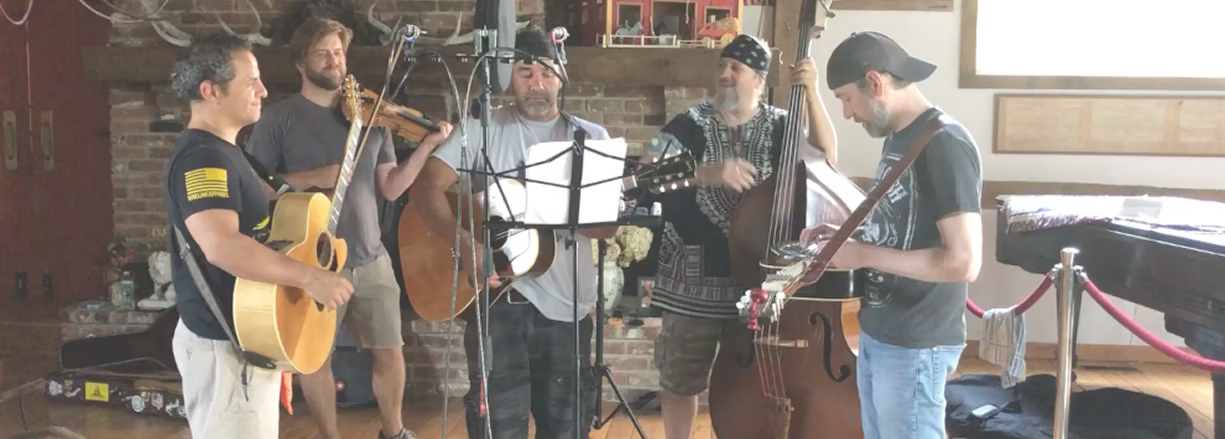
Introducing Soundkeeper Recordings
Soundkeeper Recordings are produced, recorded, and mastered by Barry Diament

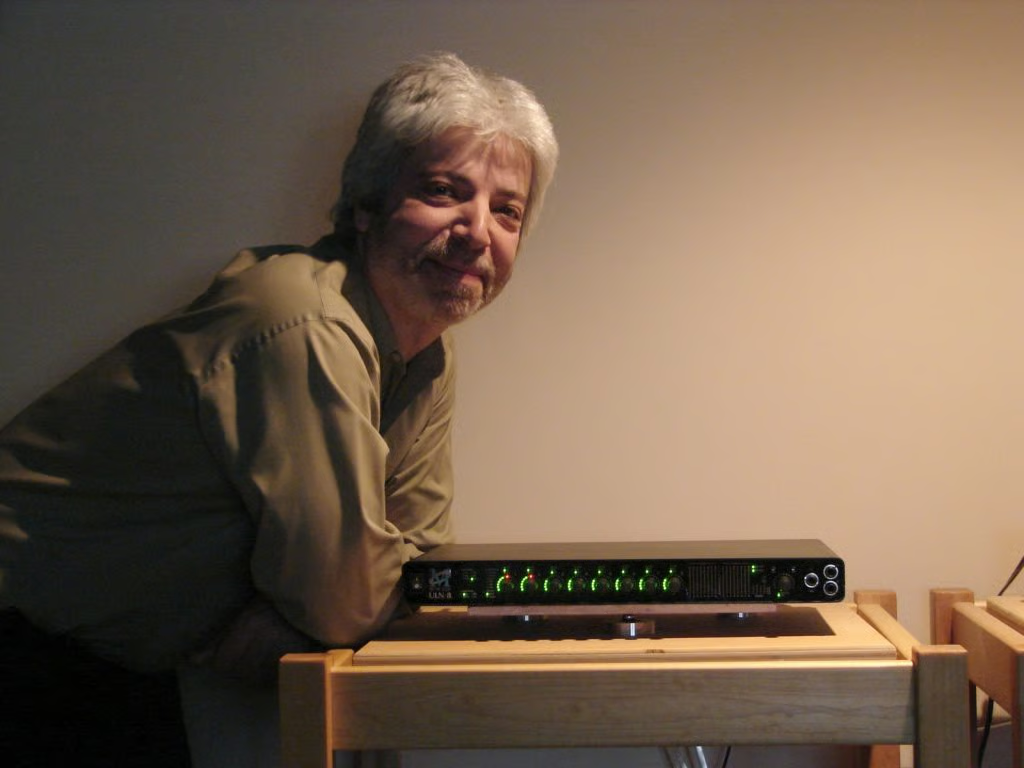
Barry Diament
I’ve been a music lover, amateur musician, and audio hobbyist since childhood, and a professional audio engineer since 1975. Having cut tracks, recorded overdubs, mixed tracks, edited tracks, and mastered for vinyl, in 1983 while at Atlantic Studios in NYC I became one of the first engineers to master for CD.
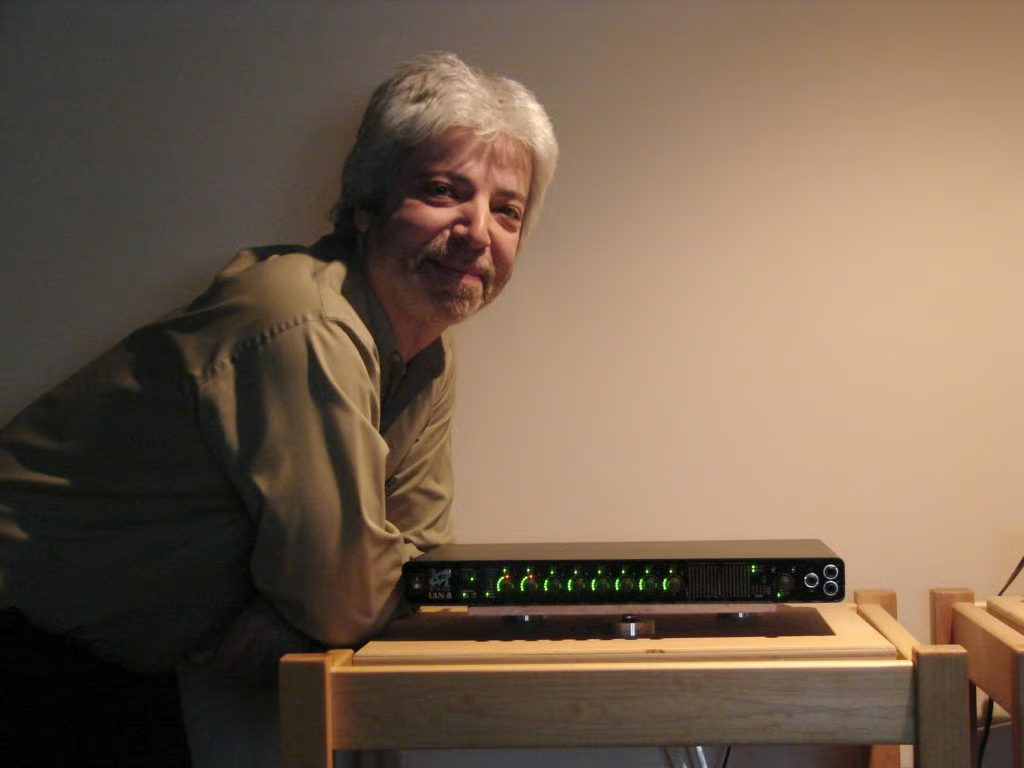
What my experience taught me is that once the signals are leaving the microphones the recording’s ultimate quality ceiling has already been determined. Everything after the microphones merely determines how much of what was captured the listener gets to hear.So, in 2006 I founded Soundkeeper Recordings to explore the idea of recordings that “get out of the way” and bring the listener to the performance, creating the feeling the listener is in the presence of the musicians, in the space where the performance actually took place.
I believe the best way to achieve the excitement of a real performance in a recording is to record a real performance. Soundkeeper Recordings are made with all the musicians playing live, in real time. They are recorded directly to stereo. There are no overdubs. There are no mixes. I call it “recording without a net.”
Background and Inspiration
Can you share your journey from being a mastering engineer at Atlantic Records to founding Soundkeeper Recordings? What inspired this transition?
My love of music led to an appreciation for high-performance audio. While there’s nothing like being in the presence of the music as it is being performed, recordings allow us to have any music we want any time we want. I was an audiophile before I started working as a professional audio engineer, so I’ve always wanted recordings to, as I put it, get out of the way.
I started doing recording and mixing before mastering, and what I came to understand is that every stage of the process after the initial recording merely determines the degree to which the listener gets to hear what was captured by the mics. In other words, the largest effect on the quality of a recording is that initial capture, what the mics “hear.” I founded Soundkeeper Recordings to explore this and to make recordings that give the listener the feeling of being in the presence of the musicians, in the space in which the performance takes place.
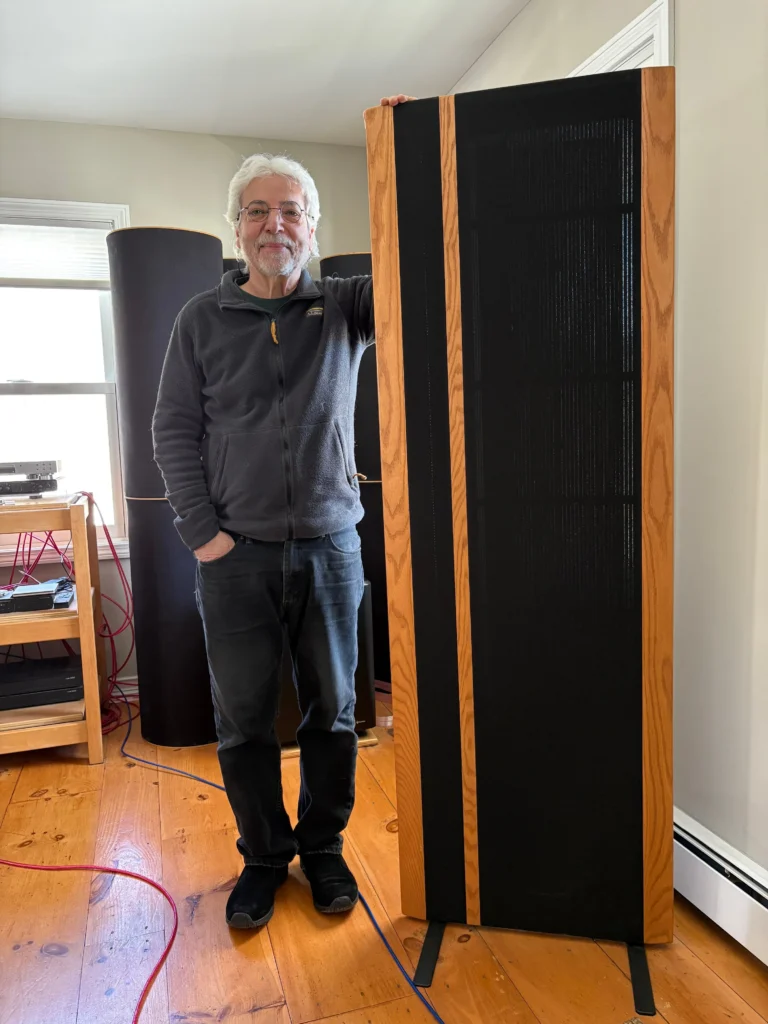
Philosophy and Approach
Soundkeeper Recordings emphasizes capturing the essence of live performances. How do you select artists and venues to align with this philosophy?
Artist selection is really dependent on a few things: I love all kinds of music so if I hear something that moves me I’ll want to hear more from the artist. After that, it is key that the artist can perform live, in real time, without the safety provided by modern studio techniques such as overdubbing to fix mistakes, mixing to change balances, etc.. Lastly, it is important that the artist is interested in the challenge of working this way, what I refer to as “recording without a net.”
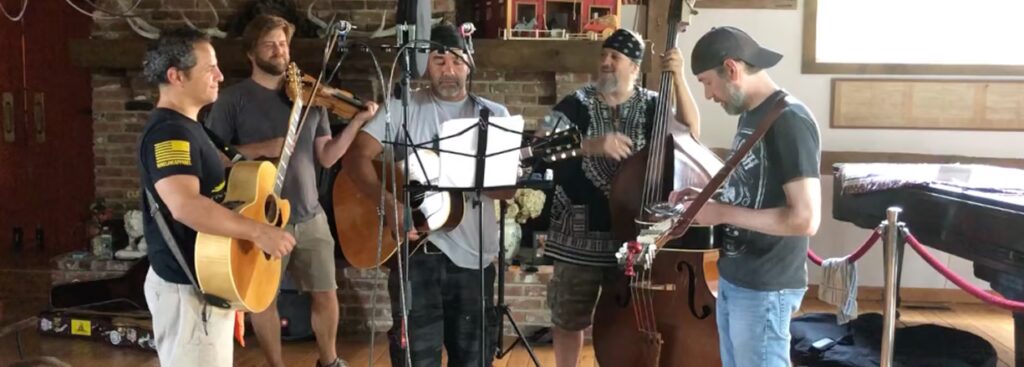
Recording sites are selected based on where I feel the music and instrumentation would best be heard by an interested listener. I find performance spaces elicit different performances than studio environments, so I’ve used small auditoriums, churches, and for the last project, which was country music, an incredible-sounding barn built in 1820.
Could you elaborate on your minimalist recording technique using a matched pair of microphones and how it impacts the final sound?
When I first apprenticed in a recording studio, the engineer I worked under used seven mics on a drum set. When I got my first shot behind the console I decided to try just three and found the result to be increased clarity. Nowadays I use none. Instead of mic’ing voices and instruments I mic the event, including the space it which it occurs.
By using a single mic per playback channel I seek to avoid multipath distortion in the audio domain. A given instrument will only have a single time arrival at each of the stereo channels. I find this contributes greatly to the sense of clarity in Soundkeeper Recordings, and to the ease with which one can focus on any particular voice or instrument in an ensemble, or on the space the players are in.
Folks old enough to remember TV antennae might recall sometimes seeing “ghost” images when the signal reaching the antenna got reflected by, for example, a nearby building. The direct signal would get to the TV followed in time by the reflected signal, resulting in multipath distortion manifesting as a second or “ghost” image superimposed on and offset from the direct image.
By using a single mic per playback channel I seek to avoid multipath distortion in the audio domain. A given instrument will only have a single time arrival at each of the stereo channels. I find this contributes greatly to the sense of clarity in Soundkeeper Recordings, and to the ease with which one can focus on any particular voice or instrument in an ensemble, or on the space the players are in.
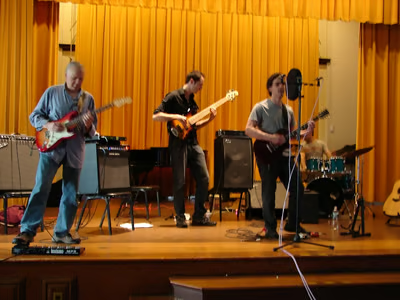
Technical Insights
You’ve mentioned that the quality ceiling of a recording is largely determined by the time signals leave the microphones. How does this belief influence your recording process?
The typical recording process today involves capturing each voice or instrument with one or more microphones (and sometimes a directly wired feed for electronic instruments). These are each placed on separate tracks of a multitrack recorder. Overdubs might be added on additional tracks. Then all the separate tracks are combined into a so-called stereo mix (or perhaps a mix destined for more than two speakers). The mix is where the final balance between all the recorded tracks is created and where instruments are electronically placed somewhere between the speakers.
With Soundkeeper Recordings the mix is effectively done before we start recording. Instead of moving faders (for balances) and pan pots (for positioning), we’ll physically move players and instruments to achieve the balance and placement I want. The real stereo capture from the microphone array takes care of the positioning by accurately rendering the location of each voice and instrument.
What role does high-resolution recording (e.g., 24-bit/192kHz) play in achieving the desired sound quality at Soundkeeper Recordings?
I mentioned earlier that I believe every stage of the process after the initial recording merely determines the degree to which the listener gets to hear what was captured by the mics. To date, the most transparent recorder in my experience does its best at 24/192, and is the most faithful way to preserve my mic feed. In addition, for the audience that wants downloads at other resolutions, like 24/96 or 16/44, or those who want CDs, I find the 24/192 capture allows me to create those other versions with greater fidelity to the original.
Challenges and Rewards
What are some challenges you’ve faced in producing recordings without overdubs or post-performance mixing?
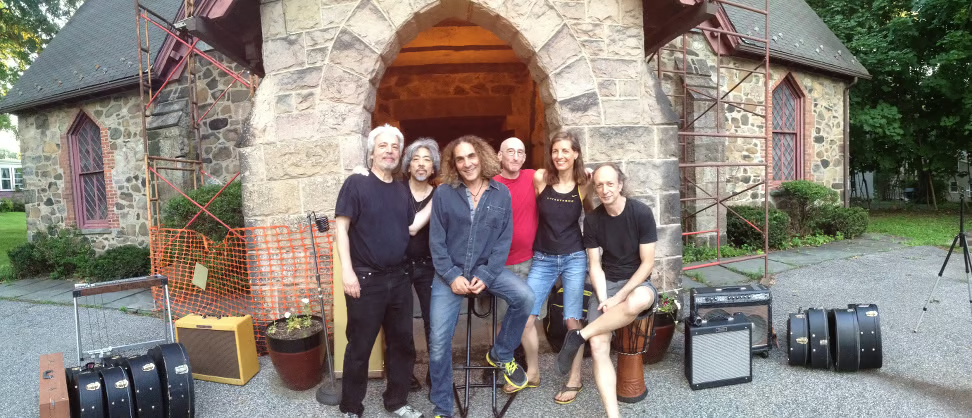
Much like recording direct-to-lacquer-disc, recording without a net means there are no opportunities to “punch in” fixes for mistakes. If anything goes wrong during the recording of a performance, the musicians have to do it all over again. Sometimes the musicians nail the performance but something else ruins a take. For example, in the session for “Lift” the band did a great run through of the song “Beautiful Dreamer.” The song is in the key of A minor and the last strum of the chord ended with the notes A, C, and E. As the last note faded away into the ambience of the space, the mics picked up a fly all the way at the back of the church, and he was buzzing at E-flat.
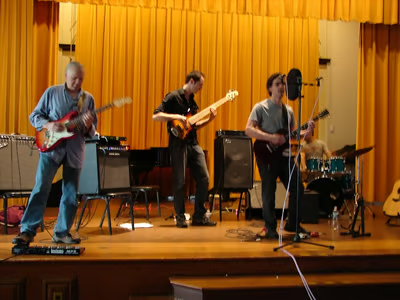
Another challenge occurred during the recording of “Equinox.” The venue was a wonderful small auditorium within an assisted living facility. I loved the sound of the room but we could only record up to a certain hour. We did one session where I felt the band was being a bit too careful, and by the time they got comfortable with my process we had to end the session. Happily, we went back the next day and the band knocked it out of the park, completing the whole album in under four hours.
Can you share a memorable experience from a recording session that exemplifies the rewards of your approach?
One of the most memorable experiences I’ve had in this pursuit occurred during the recording of the album “Kay Sa.” With all the musicians sitting together and listening to each other directly, the sounds they create are very different from those the same players would create in a recording studio where they’re often listening to each other via headphones. Without the barriers that separate the players in a studio, without the safety of being able to fix parts after the performance, and without an engineer to adjust musical balances, the energy of the performance takes on a very different character.
Early in the session, the band played “Minis Azaka,” a traditional Haitian song with original lyrics and music added. As the song proceeded, I found myself standing and swaying to the music. As the vocalist sang the lyrics in Haitian Creole, a language I do not speak or understand, I stood there wiping tears from my eyes. When the take was over, I told the band that was the most beautiful piece of music I’ve ever had the good fortune to record. I was still wiping my eyes when I learned that the lyrics are powerful and sad. I didn’t see the translation until many weeks after the session, but in those moments as they played it, without my understanding the words, the music and the vocal performance spoke to me in a profound way. Jeff Buckley was spot on when he said music isn’t merely an art form, it is a force of nature.
Industry Perspectives
How do you view the current state of the recording industry, especially concerning the prevalence of multi-microphone setups and extensive post-production?
I think there are many ways to make a satisfying music recording. The degree of success for any particular method depends entirely on exactly the type of result being sought. The goal might be to spotlight certain aspects of a sound, portraying it in a way a listener would not normally hear it. Alternatively, it might be the creation of something that is so unique it sounds completely different from what the microphones heard. The Beatles excelled at this. Or it might be to capture – to the extent recording and playback technology permit – a convincing sample of reality.
Some types of music can’t be performed live in real time, and so can’t be captured in the Soundkeeper fashion. Examples might include situations where one musician or vocalist performs more than one part, or where not all the performers are in the same place at the same time. Recording these types of performances requires multiple tracks and a post-recording mixdown of those tracks. Not to say the individual parts can’t be recorded in stereo, with the placement of parts on the soundstage determined before recording takes place. With proper planning a convincing result can still be attained. That said, I find there are still many recordings made with multiple microphones and lots of post-production that still have a magic of their own.
What advice would you offer to aspiring recording engineers who wish to capture the authenticity of live performances?
To my ears the best way to capture the true essence and excitement of a live performance is to record a live performance, and to record it in real stereo.
Put another way, I’d suggest leaving the conventional wisdom behind and breaking down the whole process into its most basic elements, and then building them back from the ground up, using what is known as a first principles methodology. It is important to ask the right questions like “Why this mic?” and “Why place it here?” and to have solid answers to those questions. Every recording decision has consequences and those must be understood to maximize success.
I suppose that would be my best advice: you can’t ask enough questions, for without the questions there are no answers.
Future Directions
Are there any upcoming projects or collaborations at Soundkeeper Recordings that you’re particularly excited about?
There are a few potential projects on the cooker for this year but none are solid yet so there isn’t much I can say. It will be my pleasure to keep you posted when there is news to share.
How do you envision the future of high-fidelity recording and playback in an increasingly digital music landscape?
You saved the toughest question for last! In the end, I believe there will always be those of us who value music as a critical part of our lives, and who will want recordings, and equipment to play those recordings, that bring us closer to the music and the emotion it contains.
Thank you for your much-appreciated interest.